
Most people hack at an onion until it falls apart into random chunks. A chef turns the same onion into a pile of neat, even squares in about twenty seconds. The difference is not speed, and it is not an expensive knife. It is one method, and once you see it you cannot unsee it.
The whole thing rests on a single idea: the onion already has a built-in grid. Its natural layers and lines do most of the cutting for you. Your job is just to work with them instead of against them.
What you need
A sharp knife and a board that does not slide. That is it. If your board wobbles, put a damp cloth or paper towel under it. A blunt knife is the number one reason home dicing goes wrong, so if you sharpen nothing else this year, sharpen the knife you use for onions.
The method, step by step
- Cut off the top, keep the root. Slice off the pointy stem end. Leave the hairy root end fully intact. The root is what holds the whole onion together while you cut, and that is the real trick. Take it off now and the onion loosens into floppy petals.
- Halve it through the root. Stand the onion on its flat top and slice straight down the middle, from root to tip. Now you have two halves, each still anchored by half a root.
- Peel and sit it flat. Pull off the papery skin. If the first layer looks dry or bruised, take that too. Lay each half flat side down so it sits still and cannot roll under your knife.
- Make the flat cuts (this is the chef part). Rest your palm gently on top of the onion. Make one or two cuts parallel to the board, running toward the root but stopping just short of it. Small onion, one cut is enough. Big onion, two. These cuts set how tall your dice will be.
- Make the downward cuts. Now cut straight down, following the onion’s own curved lines from the top toward the root. The closer together these cuts, the smaller your dice. Stop just before the root every time so nothing falls apart yet.
- Slice across and watch it rain squares. Turn and slice down across all those cuts, working from the top toward the root. Even little cubes drop off with every pass. This is the satisfying part, and it is where it finally looks like a chef did it.
- Deal with the root last. When you reach the root and the pieces stop coming out neat, stop. Slice the last good flesh off the root and throw the root away. Do not chase every scrap. It is not worth a cut finger.
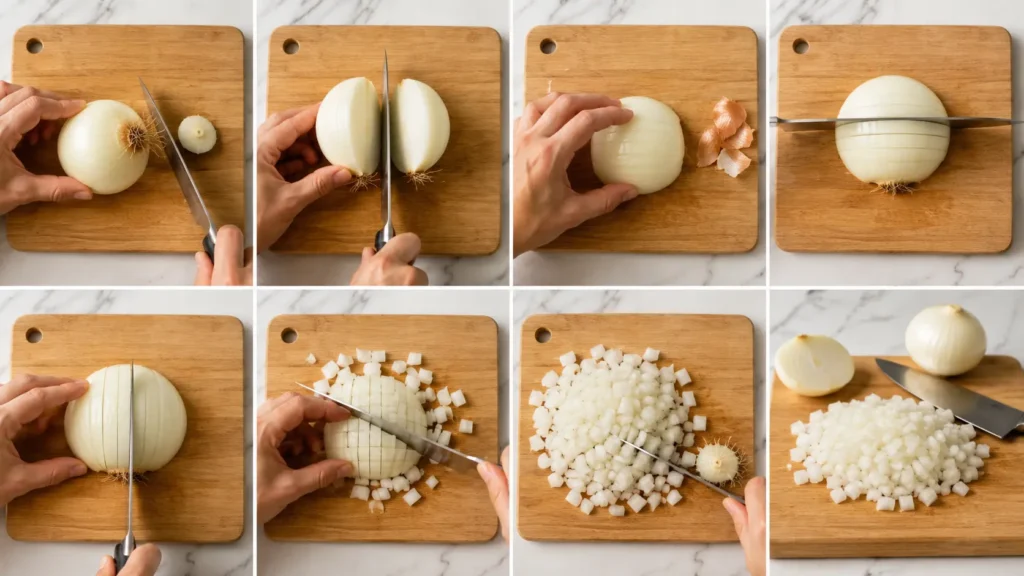
Controlling the size
Same method, different spacing. For a fine dice (a curry base, a pasta sauce, anything you want to melt into the dish), make your downward cuts close together. For a chunky dice (salad, salsa, a stir-fry), space them wider. The flat cuts and downward cuts control the size in every direction, so the pieces come out however you decide.
Three mistakes that ruin it
Cutting the root off too early. Do this and you are not dicing anymore, you are wrestling a pile of slippery layers.
A dull knife. It crushes instead of slicing, so the onion weeps everywhere and the pieces turn mushy before they hit the pan.
Flat fingers. If your holding hand keeps its fingers straight and pointing at the blade, a nick is only a matter of time. Curl your fingertips under and let your knuckles guide the side of the knife. It feels slow for about a week, then it is just how you cut.
A few quick answers
Do I really need the flat cuts in step 4?
On a small onion, no. Skip them and the downward and cross cuts still give you a fine dice. On a big onion the flat cut stops your pieces from coming out as long strips, so it is worth the extra two seconds.
What is the difference between dicing and mincing?
Dicing gives you even cubes you can see. Mincing is finer and rougher, where you rock the knife over the pile until it is nearly a paste. You mince garlic. You dice onion for most dishes.
Which knife should I use?
A chef’s knife around 8 inches. It is long enough to slice through the onion in one clean stroke, which gives you tidier pieces than sawing back and forth with a small knife.
Dice a few onions this way and the grid stops being something you think about. You just do it. That is the whole secret behind the trick that looks so impressive when a chef does it fast.